



Design, Deploy and Operate your Private AI Infrastructure
Traditional enterprise networks were built for users reaching applications. AI clusters do the opposite — hundreds of GPUs talk to each other, continuously, at line rate. The same switch fabric cannot serve both jobs well.
Users access centralized applications, databases, and internet resources through hierarchical networks. Traffic is bursty, asynchronous, and tolerant of moderate latency and jitter.
The majority of traffic stays inside the cluster: GPU-to-GPU tensor exchange, parameter sync, gradient all-reduce, checkpoint streaming. Continuous, synchronized, microsecond-sensitive.
RDMA, lossless transport, adaptive routing, in-network reduction
Every feature exists for a reason — to keep your GPUs fed, your gradients moving, and your training jobs scaling linearly across the cluster.
Zero-copy transfers straight from GPU memory to the wire. Bypass the CPU, bypass the kernel, keep tensors moving.
Collective operations like all-reduce run inside the switch fabric. Cut step time, free up GPU cycles.
The fabric reroutes around congestion in microseconds. No more hot spines tanking your scaling efficiency.
PFC and ECN tuned per-fabric. No packet drops, no NCCL timeouts, no retransmission storms killing throughput.
EVPN/VxLAN with per-tenant QoS. Many AI customers, one fabric, zero interference between training jobs.
Real-time link, queue, and NCCL signal monitoring. Watch fabric health alongside GPU utilization, not after it.
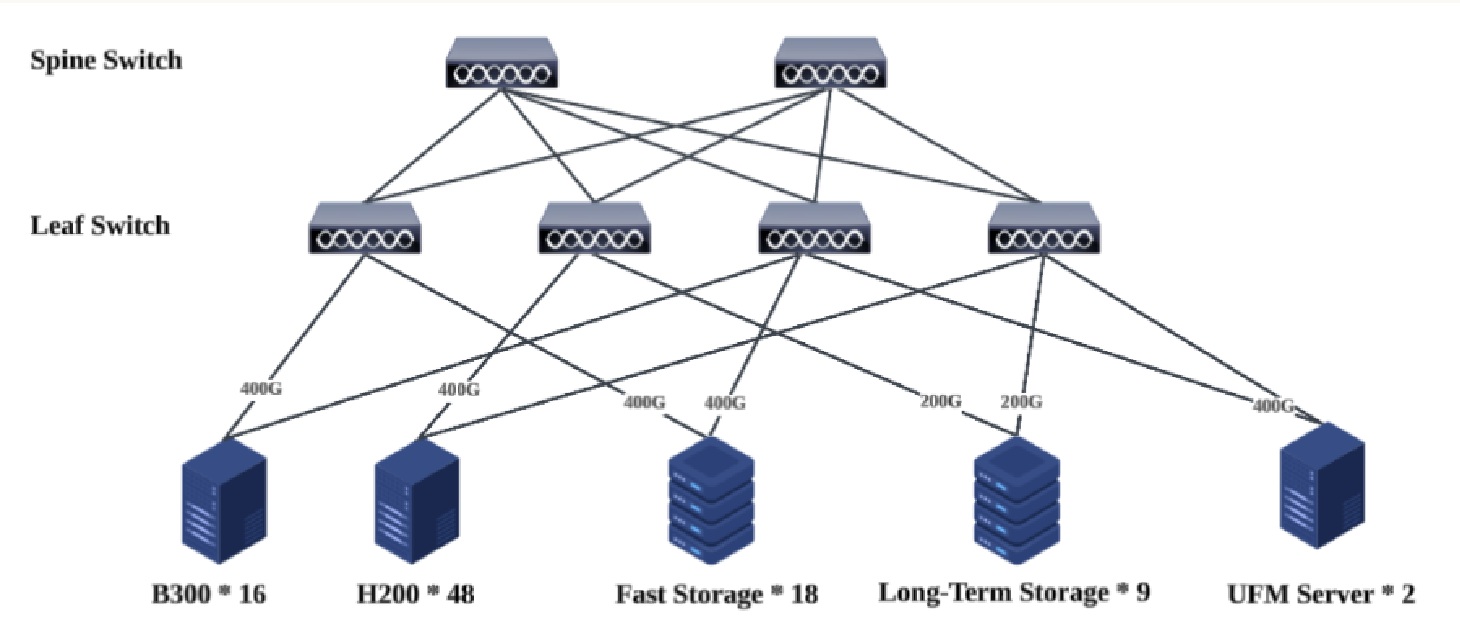
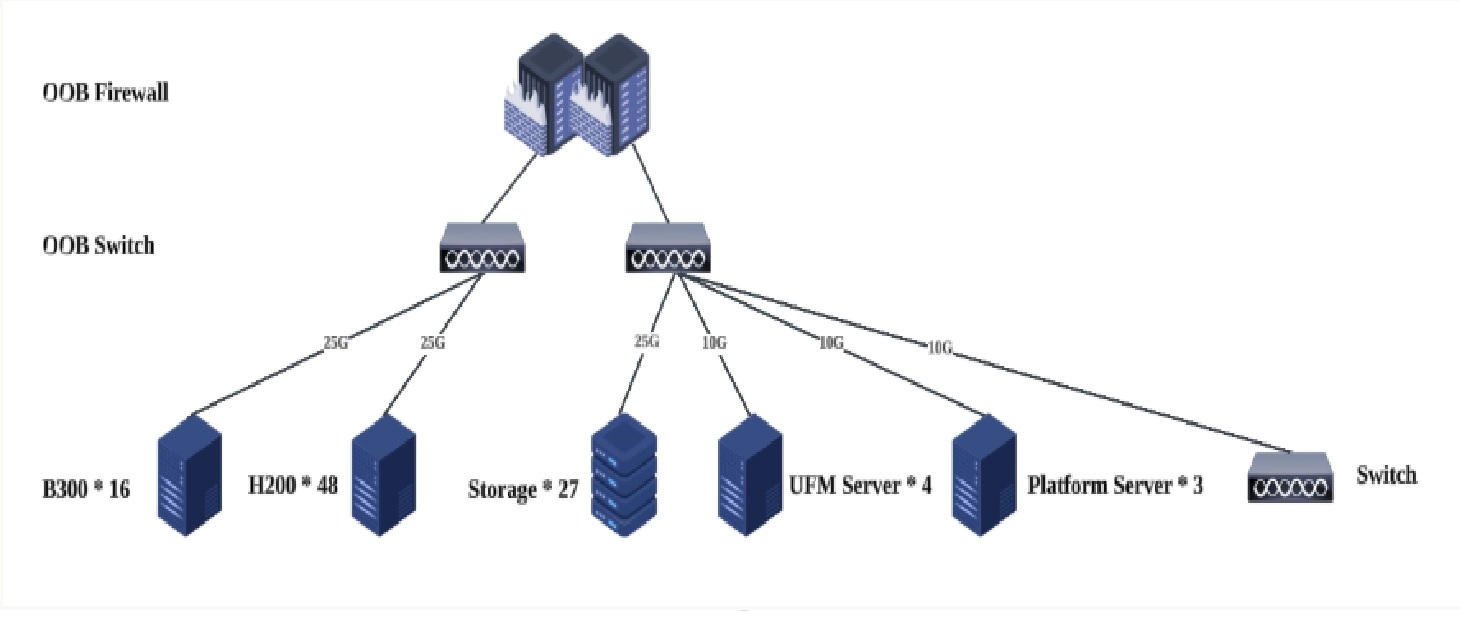
GPU-to-GPU fabric, storage fabric, and out-of-band management
A production AI cluster is not one network — it is three fabrics, each tuned for a different traffic profile. Designed independently, deployed as a single coherent system.
Numbers from production fabrics we've designed, deployed, and operated
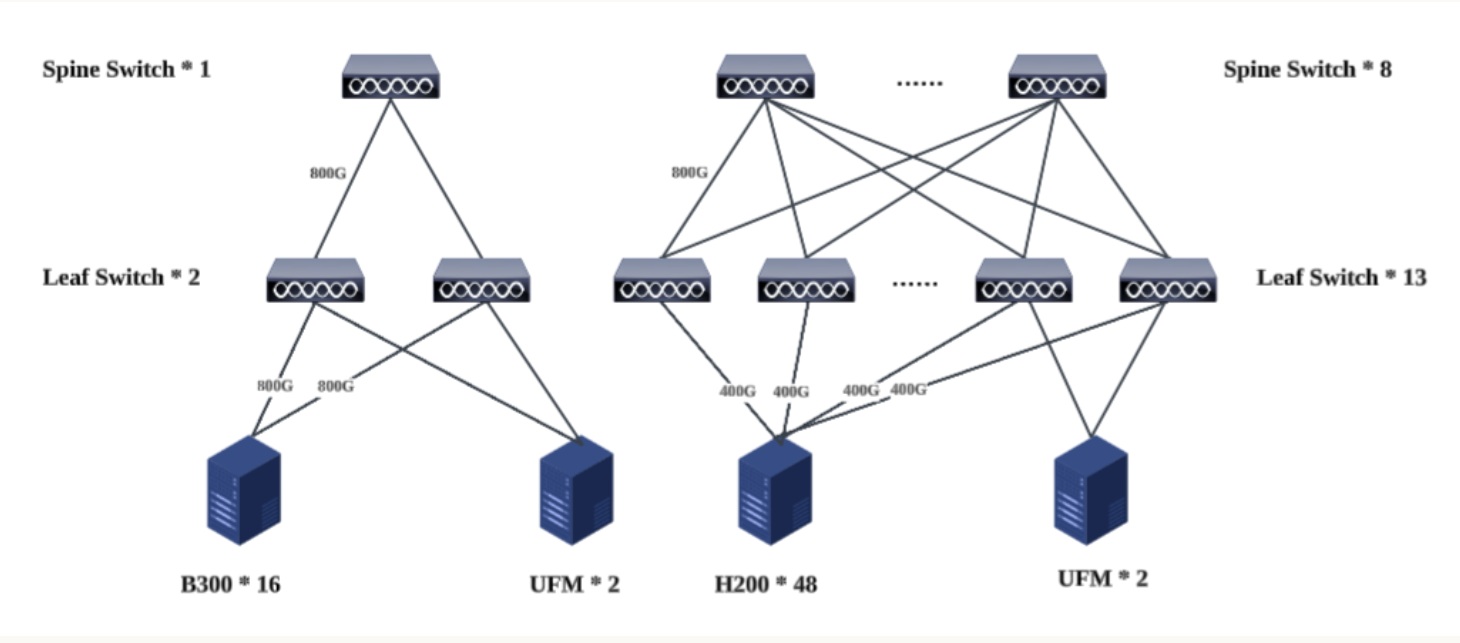
A representative 64-node H200 + B300 deployment on OneSourceCloud's reference architecture — non-blocking, lossless, RDMA end-to-end.
B300 / Blackwell-class
Deterministic, lossless
128-GPU NCCL all-reduce
Leaf-spine, no oversubscription
B300 × 16 + H200 × 48
PFC + ECN tuned
RDMA-aware monitoring
UFM-managed
A complete lifecycle for the AI fabric, from architecture to 24×7 NOC
Engineered to your workload, built into your data center, and continuously tuned as the cluster scales and the workload mix shifts. One team owns the fabric.
A non-blocking fabric engineered around your workload profile, GPU density, and growth plan. Bandwidth, latency, and oversubscription analyzed before a single port is racked.
Switch installation, structured cabling, configuration, integration, validation. The architecture becomes a production fabric tuned for GPU traffic, storage access, and distributed training.
Continuous oversight, monitoring, and tuning. AI workloads are sensitive to congestion, latency, and packet loss — proactive management is what keeps GPU utilization at the line you paid for.
We design infrastructure with strict access control, data isolation, and security best practices aligned with healthcare compliance requirements.
Yes. Our private AI infrastructure ensures full control over data location, access, and processing.
We provide monitored, production-grade infrastructure with high uptime and performance consistency.
Yes. Our GPU clusters are optimized for high-volume data processing, including imaging and genomics workloads.
We support integration with existing data pipelines and systems to minimize disruption.
We fully manage deployment, monitoring, and maintenance, so your team can focus on research and clinical applications.
Enterprise-Grade Private AI Infrastructure
Supporting organizations building and scaling Private AI environments.
Practical guidance for secure, reliable, and scalable AI environments
Our blog shares real-world insights on private AI infrastructure, operations, and platform design—based on hands-on experience managing customer-owned systems.
Secure, compliant, and fully managed AI infrastructure—designed for enterprise and regulated environments.